Your GitHub Org Has Dead Repos — Here's How to Find Them

Levi Garner
Founder & CTO, InteliG
TLDR: We audited Vercel’s GitHub org — 20 repos, 2 naming duplicate clusters, and specific recommendations for which repos to archive, merge, or rename. Every dead repo is tech debt. Audit yours → intelig.ai/tools/repo-audit
How many repositories does your GitHub org have?
Now: how many of those are actually maintained?
If you don’t know the answer, you have sprawl. And sprawl is silent technical debt.
What we found in Vercel’s org
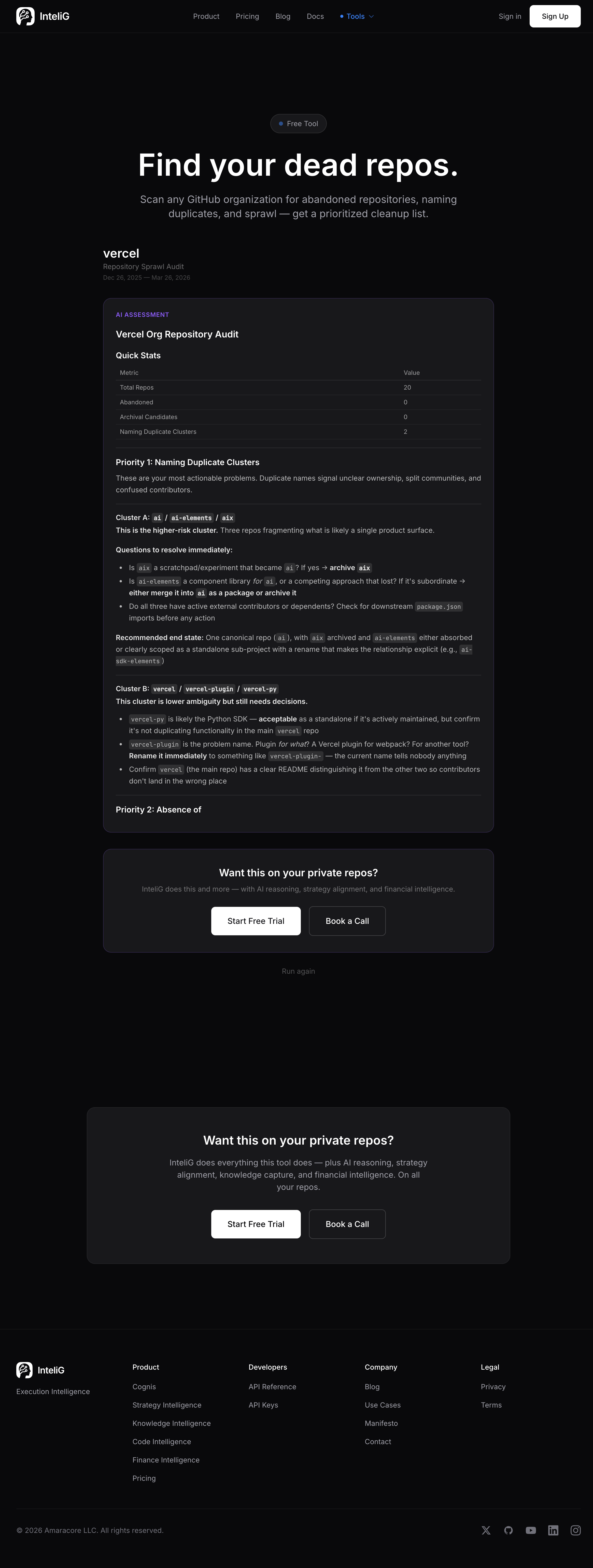
We ran Vercel through our Repo Sprawl Auditor. 20 public repos analyzed. The AI identified two naming duplicate clusters that need attention:
Cluster A: ai / ai-elements / aix
Three repos fragmenting what is likely a single product surface. The AI flagged this as the higher-risk cluster and asked pointed questions: Is aix a scratchpad that became ai? Is ai-elements a component library for ai, or a competing approach? If so — archive aix, merge ai-elements into ai as a package.
Cluster B: vercel / vercel-plugin / vercel-py
Lower ambiguity. vercel-py is likely the Python SDK — acceptable as a standalone. But vercel-plugin — plugin for what? A webpack plugin? The name tells nobody anything. The AI recommended renaming it immediately.
These aren’t theoretical suggestions. These are specific, actionable cleanup items derived from the repo names and structures.
Why repo sprawl matters
Security risk. Every unmaintained repo is an attack surface. Stale dependencies with known CVEs. GitHub Actions workflows that haven’t been updated. Secrets that might still be active.
Cognitive burden. New engineers join your org, look at the repo list, and see 47 repositories. Which ones matter? Which ones are experiments from 2023? Nobody knows, so nobody touches them. The dead repos make the living ones harder to find.
CI/CD waste. If you have GitHub Actions running on repos nobody cares about, you’re burning compute. Dependabot is opening PRs on abandoned repos that nobody will ever review.
Naming confusion. When two repos have similar names (api and api-v2, utils and shared-utils), contributors commit to the wrong one. Knowledge fragments. The codebase splits where it should be unified.
What the auditor checks
Paste any public GitHub org URL. The tool analyzes:
- Total repos and activity status
- Abandoned repos — not pushed to in 90+ days, not archived
- Archival candidates — repos with DEAD or STALE status
- Naming duplicates — repos with overlapping names that suggest fragmentation
- AI analysis — prioritized cleanup recommendations with specific actions per cluster
The AI doesn’t just list problems. It tells you what to do about each one: archive this, merge that, rename this.
The cleanup process
Start with the audit results. Then:
- Archive anything that hasn’t been touched in 6+ months and has no downstream dependents
- Merge fragmented repos that serve the same purpose (check for cross-repo imports first)
- Rename anything that doesn’t clearly communicate its purpose
- Document the repos that survive — a one-line description in each README is the minimum
Do this quarterly. Repo sprawl is like weeds — it grows back if you don’t maintain it.
See What Your Engineering Org Is Really Doing
InteliG reads your repos, analyzes every commit, and gives you the execution intelligence CTOs actually need.
Start Your Trial